
Why Focused Shockwave Therapy Can Be A Gamechanger
Blog by Dr. Melissa Barber
A lot of people wait to receive medical care when:
1) pain levels are moderate to severe, and/or
2) function is rather impaired.
By this stage, tissue injury is often advanced. Patients may do this because they are frequently told to “wait until it’s bad enough for surgery”, especially for degenerative conditions like arthritis. But what if surgery was preventable? What if you could intervene earlier to not just manage pain, but actually regenerate the area?
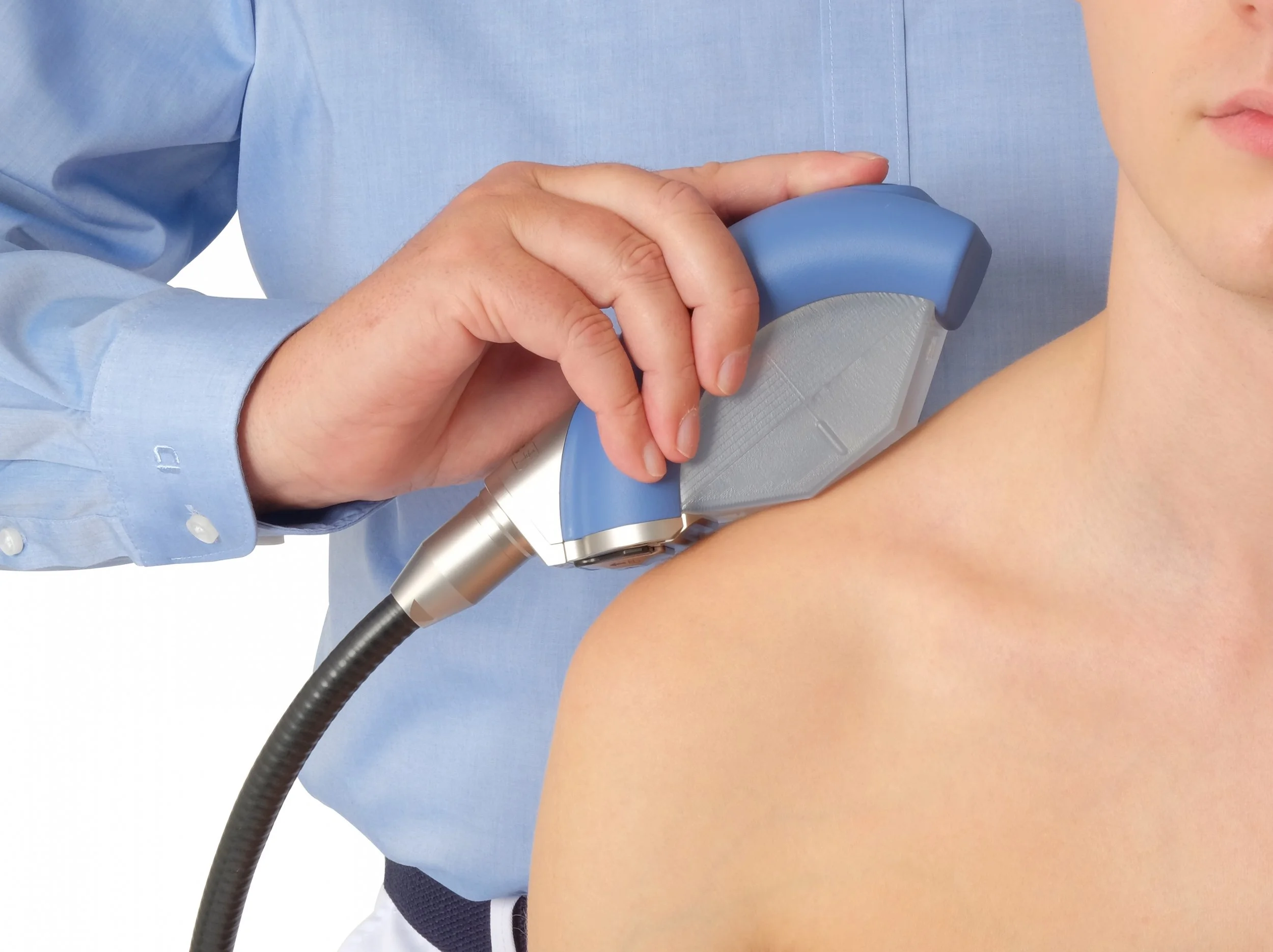
Enter: Focused Shockwave Therapy (also known as Extracorporeal Focused Shockwave Therapy or ESWT), which is a sophisticated technology that delivers acoustic waves into the body. Unlike Radial Pressure Waves (which are often mislabeled as “shockwave”), Focused Shockwave is highly precise.
Also consider: Regenerative Injection Therapies like Prolotherapy and Platelet-Rich Plasma (PRP). We’ll reserve those for another post. Although injection therapies can be highly effective for different conditions, not very many people like needles, so ESWT can be a good option!
Focused Shockwave Therapy technology works through a process called mechanotransduction. Essentially, the acoustic energy “wakes up” the cellular environment, triggering a healing cascade by:
Increasing Circulation: Blood flow is directed to the injured site.
Releasing Growth Factors: Your body’s natural repair signals are activated.
Recruiting Stem Cells: Regenerative cells are drawn to the area to rebuild tissue.
Focused vs. Radial: Why the Technology Matters
It is important to understand the difference between a true Focused Shockwave machine and a Radial Pressure Wave (RPW) machine.
Radial Pressure Wave (RPW): A RPW machine delivers microtrauma to the tissue (similar to bruising) to encourage healing, but it is nonspecific and doesn’t penetrate very deeply. Think of this like a flashlight. The energy is strongest at the skin’s surface and spreads out as it goes deeper. The machine is a lot cheaper and therefore, is more broadly offered.
Focused Shockwave: The energy converges at a specific point deep within the tissue. Think of this like a laser. Because the “pads” on the probe head can be adjusted for different depths and are different sizes, a clinician with a strong understanding of anatomy can target the exact source of your pain.
Why Piezowave?
There are various types of focused technology (electrohydraulic, electromagnetic, and piezoelectric). I utilize piezoelectric/Piezowave because of its clinical accuracy and the ability to adjust power levels quickly to match patient comfort and tissue needs.
Better Results, Earlier
While we can treat chronic, long-standing injuries, there is a massive advantage to treating conditions when they are new, mild, or moderate. When we catch an injury early, there is a significantly higher likelihood of fully reversing the damage. When paired with systemic support and targeted exercises, this non-invasive approach can be the key to avoiding the operating room.
Conditions Treated with Focused Shockwave (now this is not an exhaustive list, but a good start!)1-19:
Head, Nerve, & Spine: TMJ Dysfunction, Peripheral Neuropathy, Chronic Neck/Back Trigger Points & SI Joint Pain.
Arm & Shoulder: Tennis/Golfer’s Elbow, Carpal Tunnel, Dupuytren’s Contracture, Calcific Tendonitis, & Frozen Shoulder.
Leg & Hip: Patellar Tendinopathy, Hip Bursitis (GTPS), Shin Splints & Other Bone Stress Reactions.
Foot & Ankle: Plantar Fasciitis, Achilles Tendinopathy, & Morton’s Neuroma.
What to Expect
Duration: Each session typically takes 15–25 minutes.
Timeline: While the biological repair starts immediately, the best results are typically seen after 6 weeks of once-weekly treatments.
Next Steps: If you are curious if this technology is right for your specific injury, we offer a 25-minute screening visit for new patients interested exclusively in Focused Shockwave.
Don’t wait for “bad enough”. Contact us to see if we can help you get back to doing what you love!
In health,
Dr. Melissa Barber
Dr. Melissa S. Barber, ND, MSc, E-RYT 500, NTP is passionate about helping patients move beyond symptom management to true healing. She takes a whole-person, multi-system approach—connecting the constellation of symptoms to diagnose and treat root causes. Dr. Melissa is evidence-informed and results-driven, with focus on restoring function, returning patients to activity, and improving quality of life. See what patients have to say about Dr. Melissa by clicking here!
Practice location: Santa Rosa, CA; Bay Area
References
1. De La Corte-Rodriguez H, Román-Belmonte JM, Rodríguez-Damiani BA, Vázquez-Sasot A, Rodríguez-Merchán EC. Extracorporeal shock wave therapy for the treatment of musculoskeletal pain: a narrative review. Healthcare. 2023;11.doi:10.3390/healthcare11212830
2. Yusof TTT, Seow D, Vig KS. The musculoskeletal applications of extracorporeal shockwave therapy for foot and ankle disorders: a systematic review and meta-analysis. Journal of the American Podiatric Medical Association. 2021. doi:10.7547/18-191
3. Majidi L, Khateri S, Nikbakht N, Moradi Y, Nikoo M. The effect of extracorporeal shock-wave therapy on pain in patients with various tendinopathies: a systematic review and meta-analysis of randomized control trials. BMC Sports Science, Medicine and Rehabilitation. 2024;16. doi:10.1186/s13102-024-00884-8
4. Charles R, Fang L, Zhu R, Wang J. The effectiveness of shockwave therapy on patellar tendinopathy, Achilles tendinopathy, and plantar fasciitis: a systematic review and meta-analysis. Frontiers in Immunology. 2023;14. doi:10.3389/fimmu.2023.1193835
5. Speed C. A systematic review of shockwave therapies in soft tissue conditions: focusing on the evidence. British Journal of Sports Medicine. 2013;48:1538 - 1542. doi:10.1136/bjsports-2012-091961
6. Melese H, Alamer A, Getie K, Nigussie F, Ayhualem S. Extracorporeal shock wave therapy on pain and foot functions in subjects with chronic plantar fasciitis: systematic review of randomized controlled trials. Disability and Rehabilitation. 2021;44:5007 - 5014.doi:10.1080/09638288.2021.1928775
7. Auersperg V, Trieb K. Extracorporeal shock wave therapy: an update. EFORT Open Reviews. 2020;5:584 - 592. doi:10.1302/2058-5241.5.190067
8. Korakakis V, Whiteley R, Tzavara A, Malliaropoulos N. The effectiveness of extracorporeal shockwave therapy in common lower limb conditions: a systematic review including quantification of patient-rated pain reduction. British Journal of Sports Medicine. 2017;52:387 - 407. doi:10.1136/bjsports-2016-097347
9. Schroeder AN, Tenforde A, Jelsing EJ. Extracorporeal shockwave therapy in the management of sports medicine injuries. Current Sports Medicine Reports. 2021;20:298- 305. doi:10.1249/jsr.0000000000000851
10. Topalović I, Nešić D. Application of shock wave therapy in the treatment of calcific tendinopathies. Medicinski Podmladak. 2022. doi:10.5937/mp73-35808
11. Reilly J, Bluman E, Tenforde A. Effect of Shockwave Treatment for management of upper and lower extremity musculoskeletal conditions: a narrative review. PM&R. 2018;10.doi:10.1016/j.pmrj.2018.05.007
12. Crevenna R, Mickel M, Schuhfried O, Gesslbauer C, Zdravkovic A, Keilani M. Focused extracorporeal shockwave therapy in physical medicine and rehabilitation. Current Physical Medicine and Rehabilitation Reports. 2020;9:1 - 10. doi:10.1007/s40141-020-00306-z
13. Rau O, Cheng J, Jivanelli B, Tenforde A, Wyss J. Extracorporeal shockwave therapy for tendinopathies around the hip and pelvis: a systematic review. HSS journal: the Musculoskeletal Journal of Hospital for Special Surgery. 2025.doi:10.1177/15563316251332189
14. Simplicio C, Purita J, Murrell W, Santos G, Santos RGD, Lana JF. Extracorporeal shockwave therapy mechanisms in musculoskeletal regenerative medicine. Journal of Clinical Orthopaedics and Trauma. 2020;11 Suppl 3: S309-S318. doi:10.1016/j.jcot.2020.02.004
15. Romeo P, Lavanga V, Pagani D, Sansone V. Extracorporeal shock wave therapy in musculoskeletal disorders: a review. Medical Principles and Practice. 2013;23:7 - 13.doi:10.1159/000355472
16. Wang Q, Zhang Q, Gao F, Sun W. Focused extra-corporeal shockwave treatment during early stage of osteonecrosis of femoral head. Chinese Medical Journal. 2019;132:1867 -1869. doi:10.1097/cm9.0000000000000331
17. Wang C. Extracorporeal shockwave therapy in musculoskeletal disorders. Journal of Orthopaedic Surgery and Research. 2012;7:11 - 11. doi:10.1186/1749-799x-7-11
18. Cao B, Tang X, Liu C, et al. Unlocking new Frontiers: The cellular and molecular impact of extracorporeal shock wave therapy (ESWT) on central nervous system (CNS) disorders and peripheral nerve injuries (PNI). Experimental Neurology. 2024;384.doi:10.1016/j.expneurol.2024.115052
19. Fiani B, Davati C, Griepp D, Lee J, Pennington E, Moawad CM. Enhanced spinal therapy: extracorporeal shock wave therapy for the spine. Cureus. 2020;12. doi:10.7759/cureus.11200
